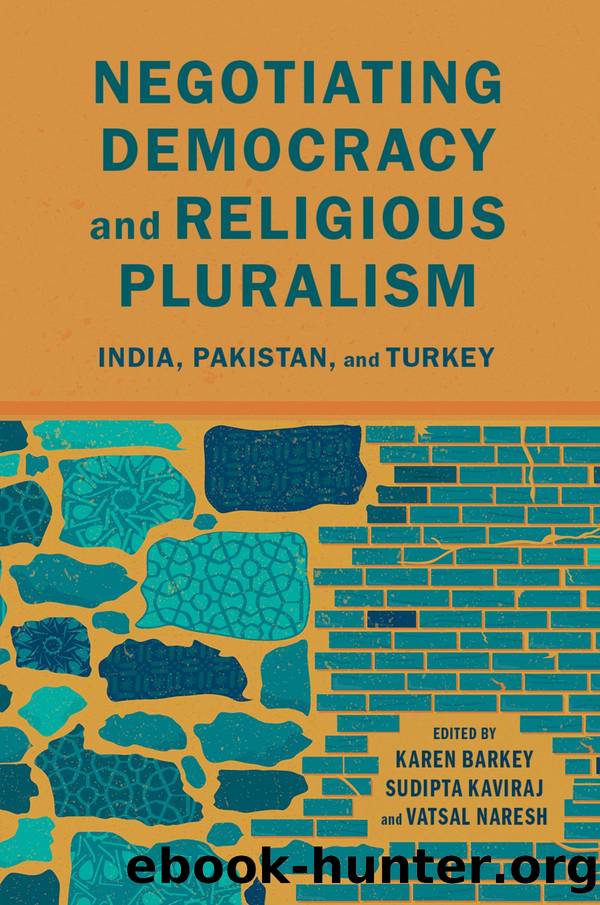
Negotiating Democracy and Religious Pluralism: India, Pakistan, and Turkey by Karen Barkey & Sudipta Kaviraj & Vatsal Naresh
Author:Karen Barkey & Sudipta Kaviraj & Vatsal Naresh [Barkey, Karen & Kaviraj, Sudipta & Naresh, Vatsal]
Language: eng
Format: epub
Tags: political science, Comparative Politics, Religion, Religion; Politics & State
ISBN: 9780197530023
Google: FWQzzgEACAAJ
Publisher: Oxford University Press
Published: 2021-08-17T00:29:19.764551+00:00
8.4.2. Ireland/India as Empty Signifier
Although Pakistanâs Second Constitutional Amendment redefined the Ahmadiyya as ânon-Muslimsâ in 1974, the Pakistani judiciary did not immediately jettison its traditional reading of religious freedom. Even one year after the military coup that replaced Prime Minister Zulfiqar Ali Bhutto with General Zia-ul-Haq in 1977, the Lahore High Court decided a case known as A.R. Mubashir v. A.A. Shah, noting that, although official recognition of the Ahmadiyya as âMuslimsâ was now constitutionally barred, their fundamental right to peaceful religious practice was still intact. In effect, the court held that the peaceful religious practices of Pakistanâs Ahmadi community (including references to their places of worship as âmosquesâ) were neither a provocation amounting to a public nuisance nor a threat to any group-based right associated with denominational âproperty.â Again, recalling the case of A.K. Shorish Kashmiri (1969), the court simply reiterated that the Ahmadiyya could be excluded from âMuslimâ matters only when those matters were clearly defined by the terms of constitutional lawâfor example, matters of âpublic officeâ or âproperty.â
At the same time, however, just across the border in India, the Indian Supreme Court had begun to modify its own understanding of group-based religious freedoms, highlighting the power of the state to identify the âessentialâ practices of any religion and, by extension, any ânonessentialâ practices that might be subject to legal regulation, restriction, or reform (Ahmad 2014: 13). This âIndianâ notionâthat states were empowered to regulate the ânonessentialâ features of any religion (outlined by Mathew John in Chapter 9 in this volume)âwas also in place during Pakistanâs first CA (1947â54), wherein a provisional article was adopted stipulating that, âsubject to regulations,â every religious denomination âshall have the right to procure . . . articles which are proved as being essential for worshipâ (1954: Article 12). But, in Pakistan, this constitutional provision was dropped in 1956, forcing future Pakistani judges to rely on jurisprudence from India (rather than their own constitution) whenever they sought to consider the statutory regulation of any religious practice that might be deemed ânonessential.â23
Still, Indian and Pakistani judges adopted very different approaches to the notion of âessentialâ and ânonessentialâ religious practices. Whereas Indian judges sought to regulate an ever-expanding notion of ânonessentialâ religious practices, for instance, Pakistani judges chose to stress (a) âessentialâ Muslim practices (protected from adverse forms of state encroachment) as well as (b) âessentialâ non-Muslim practices construed as a provocation to public disorder (and, then, legally restricted as such).24
During the dictatorship of Pakistanâs General Zia ul-Haq (1977â88), for instance, officials faced with yet another round of violent protests by right-wing religious activists stepped in to further restrict the formal parameters of Ahmadi religious freedom.25 In particular, they stepped in to prevent the Ahmadiyya from using ostensibly âMuslimâ words (e.g., masjid, or mosque) and âMuslimâ practices (e.g., the azan, or call to prayer), describing their attachment to such words and practices as a provocative form of âencroachmentâ on the special religious âpropertyâ of Muslims.
This notion that Muslim property might include words like masjid as
Download
This site does not store any files on its server. We only index and link to content provided by other sites. Please contact the content providers to delete copyright contents if any and email us, we'll remove relevant links or contents immediately.
| Africa | Americas |
| Arctic & Antarctica | Asia |
| Australia & Oceania | Europe |
| Middle East | Russia |
| United States | World |
| Ancient Civilizations | Military |
| Historical Study & Educational Resources |
Machine Learning at Scale with H2O by Gregory Keys | David Whiting(4396)
Never by Ken Follett(4065)
Fairy Tale by Stephen King(3475)
Oathbringer (The Stormlight Archive, Book 3) by Brandon Sanderson(3339)
The Man Who Died Twice by Richard Osman(3143)
Will by Will Smith(3005)
Rationality by Steven Pinker(2436)
Can't Hurt Me: Master Your Mind and Defy the Odds - Clean Edition by David Goggins(2414)
The Dark Hours by Michael Connelly(2378)
Friends, Lovers, and the Big Terrible Thing by Matthew Perry(2301)
The Dawn of Everything: A New History of Humanity by David Graeber & David Wengrow(2281)
Principles for Dealing With the Changing World Order: Why Nations Succeed and Fail by Ray Dalio(2110)
HBR's 10 Must Reads 2022 by Harvard Business Review(1902)
A Short History of War by Jeremy Black(1896)
A Game of Thrones (The Illustrated Edition) by George R. R. Martin(1832)
Go Tell the Bees That I Am Gone by Diana Gabaldon(1803)
Kingdom of Ash by Maas Sarah J(1746)
515945210 by Unknown(1706)
443319537 by Unknown(1602)
